
Follow us on Facebook
Breaking updates in your feed — tap to open
In the competitive landscape of technology leadership, few companies offer as compelling a case study as Apple. The company’s journey from near-bankruptcy to becoming the world’s first $3 trillion corporation spans two distinct leadership eras, each offering unique lessons for today’s tech professionals, entrepreneurs, and business leaders. While many debates focus on declaring a “winner” between Steve Jobs and Tim Cook, the real value lies in understanding how their complementary approaches solved different problems at different stages of Apple’s evolution.
This analysis examines the fourteen-year tenures of both CEOs, not as a competition, but as a masterclass in adaptive leadership. From Jobs’ product revolution to Cook’s operational mastery, we extract actionable strategies that can be applied to smartphone development, gadget innovation, and tech business management.
- The Visionary Revolution: Steve Jobs’ High-Risk Innovation Strategy
- Problem: Commoditized Computing and Disconnected Devices
- Solution: Integrated Ecosystems and Design-First Thinking
- The Operational Excellence Era: Tim Cook’s Steady Expansion Strategy
- Problem: Scaling Innovation and Managing Global Complexity
- Solution: Ecosystem Expansion and Operational Precision
- Comparative Analysis: Key Metrics and Strategic Outcomes
- Financial Performance Comparison
- Product Portfolio Evolution
- Practical Applications for Tech Professionals and Entrepreneurs
- When to Embrace Jobs-Style Innovation
- When to Apply Cook-Style Operations
- Balancing Both Approaches
- Conclusion: Beyond the False Dichotomy
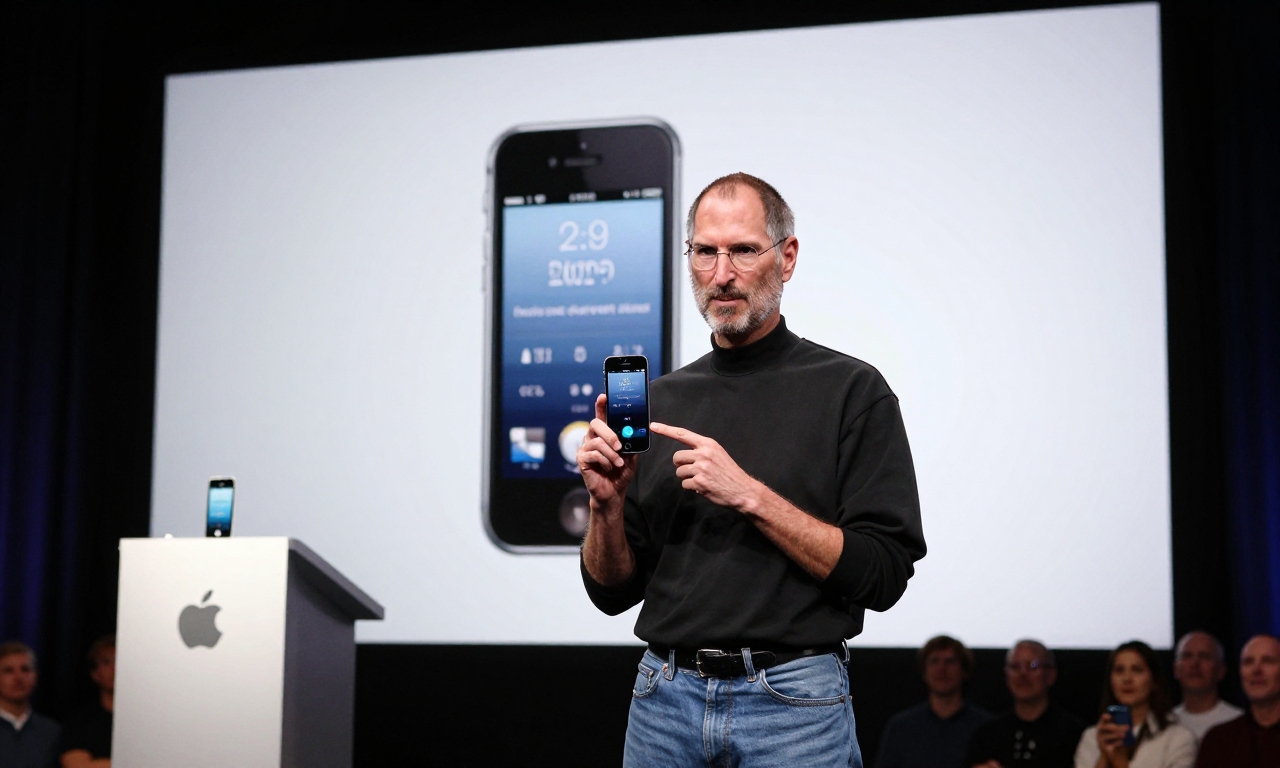
The Visionary Revolution: Steve Jobs’ High-Risk Innovation Strategy
When Steve Jobs returned to Apple in 1997, the company was struggling with $8.3 billion in annual revenue and lacked clear direction in the rapidly evolving tech market. His leadership approach centered on what we now recognize as a problem/solution framework that transformed multiple industries.
Problem: Commoditized Computing and Disconnected Devices
In the late 1990s, personal computers had become largely interchangeable commodities, while digital devices operated in isolated silos. Users faced:
- Complex interfaces that required technical expertise
- Disconnected ecosystems where devices couldn’t communicate
- Bland, beige boxes that lacked aesthetic appeal
- Software and hardware developed by separate companies
Solution: Integrated Ecosystems and Design-First Thinking
Jobs addressed these problems through a series of interconnected solutions that redefined consumer technology:
- The iMac (1998): Introduced design as a competitive advantage, proving that computers could be both functional and beautiful
- The iPod + iTunes (2001): Solved music piracy and device compatibility issues by creating a seamless hardware-software ecosystem
- The iPhone (2007): Revolutionized mobile communication by combining phone, internet, and media in an intuitive touch interface
- The iPad (2010): Created an entirely new product category between smartphones and laptops
“Innovation distinguishes between a leader and a follower.” – Steve Jobs
Jobs’ leadership style emphasized several key principles that remain relevant for today’s tech innovators:
- Embrace Failure as Learning: Products like the Lisa and Newton provided crucial lessons that informed later successes
- Simplify Complexity: The “it just works” philosophy made advanced technology accessible to mainstream users
- Control the Experience: Vertical integration ensured quality control across hardware, software, and services
- Think Different: Challenging industry conventions led to breakthrough products that competitors initially dismissed
The Operational Excellence Era: Tim Cook’s Steady Expansion Strategy
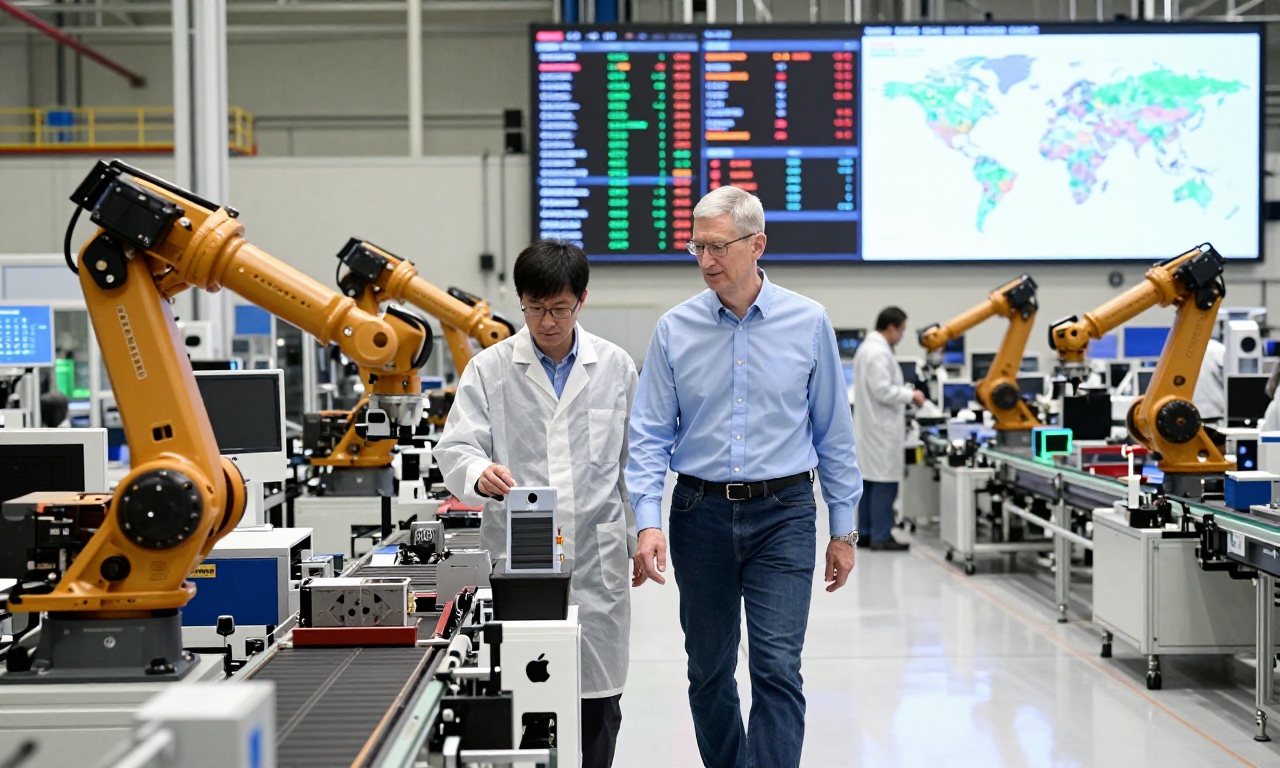
When Tim Cook took over in 2011, Apple faced a fundamentally different set of challenges. The company had become a market leader with massive scale, requiring a shift from revolutionary innovation to sustainable growth and operational mastery.
Problem: Scaling Innovation and Managing Global Complexity
Cook inherited a company that needed to solve problems of scale, diversification, and global operations:
| Challenge | Impact | Cook’s Approach |
|---|---|---|
| Supply chain complexity | Production bottlenecks and quality control issues | Just-in-time manufacturing optimization |
| Market saturation | Slowing iPhone growth in mature markets | Services diversification and emerging market expansion |
| Environmental responsibility | Growing consumer and regulatory pressure | Carbon neutrality commitments and recycling programs |
| Global operations | Geopolitical tensions and trade uncertainties | Supply chain diversification and local manufacturing |
Solution: Ecosystem Expansion and Operational Precision
Cook’s leadership transformed Apple from a product company into an integrated ecosystem powerhouse:
- Services Growth: Developed Apple Music, iCloud, Apple TV+, and App Store services into a $90+ billion annual business
- Wearable Dominance: Made Apple Watch and AirPods market leaders through iterative improvement and ecosystem integration
- Chip Independence: The M-series silicon transition reduced reliance on third-party suppliers while improving performance
- Environmental Leadership: Established industry-leading sustainability goals and achieved carbon neutrality for corporate operations
Cook’s operational philosophy demonstrates several principles crucial for scaling tech businesses:
- Consistency Over Flash: Steady, predictable improvement builds long-term trust with investors and consumers
- Team Empowerment: Distributed leadership allows for specialized expertise across different business units
- Risk Management: Careful diversification protects against market fluctuations and supply chain disruptions
- Incremental Innovation: Small, regular improvements often deliver more value than occasional breakthroughs
Comparative Analysis: Key Metrics and Strategic Outcomes
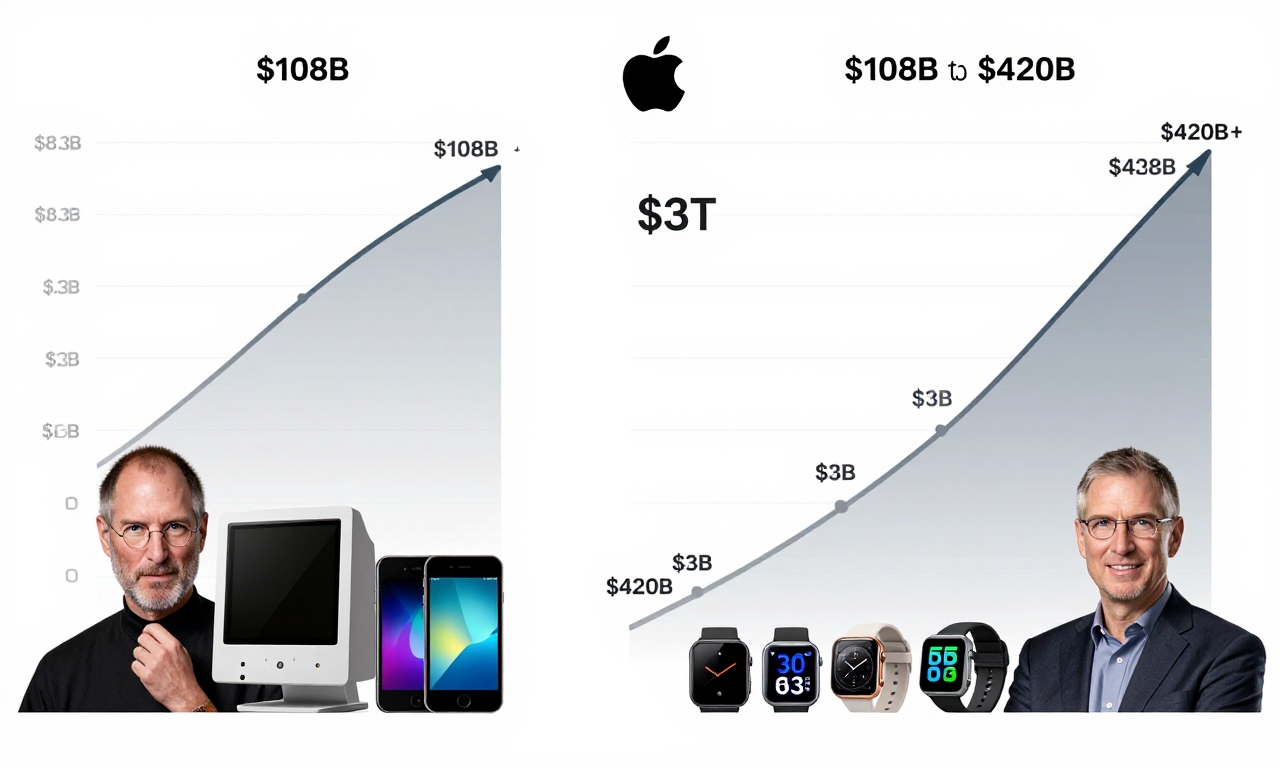
Examining the quantitative results of both leadership approaches reveals how each solved different business problems at different stages of Apple’s growth:
Financial Performance Comparison
| Metric | Jobs Era (1997-2011) | Cook Era (2011-2025) | Growth Factor |
|---|---|---|---|
| Annual Revenue | $8.3 billion → $108 billion | $108 billion → $420+ billion | 50x total increase |
| iPhone Sales | 0 → 40 million annually | 40 million → 200+ million annually | 5x increase |
| Market Capitalization | $3 billion → $350 billion | $350 billion → $3 trillion | 1000x total increase |
| Services Revenue | Negligible | $90+ billion annually | New business category |
Product Portfolio Evolution
The transition between eras reflects a strategic shift in how Apple approaches product development:
- Jobs Era Focus: Creating new product categories (iPhone, iPad) and defining user experiences
- Cook Era Focus: Expanding existing categories (Apple Watch iterations) and building connective tissue between products
- Common Thread: Both leaders maintained premium positioning and ecosystem integration as core principles

Practical Applications for Tech Professionals and Entrepreneurs
The most valuable aspect of studying Apple’s dual leadership model lies in its practical applications. Here’s how you can apply these lessons to your own tech projects, business ventures, or career development:
When to Embrace Jobs-Style Innovation
Adopt visionary, high-risk approaches when facing these situations:
- Market Disruption Opportunities: When existing solutions are inadequate or overly complex
- Early-Stage Ventures: When establishing brand identity and market position
- Technology Transitions: During shifts like 5G adoption or foldable device development
- Design Challenges: When user experience needs radical simplification
When to Apply Cook-Style Operations
Implement steady, systematic approaches in these contexts:
- Scaling Businesses: When moving from startup to growth phase
- Product Refinement: Improving existing gadgets through iterative updates
- Supply Chain Management: Optimizing production of popular devices like smartphones
- Team Development: Building specialized expertise across different technology domains
Balancing Both Approaches
The most successful tech leaders learn to integrate elements from both models:
- Visionary Execution: Set ambitious goals (Jobs) but implement them through systematic processes (Cook)
- Innovation Within Constraints: Use operational excellence to enable rather than restrict creativity
- Team Diversity: Balance visionary thinkers with operational specialists in leadership teams
- Adaptive Strategy: Shift emphasis between innovation and optimization based on market conditions
Conclusion: Beyond the False Dichotomy
The Jobs-versus-Cook debate often presents a false choice between innovation and operations. In reality, successful technology leadership requires both capabilities, applied at the right times and in the right measures. Apple’s sustained success demonstrates that:
- Revolutionary innovation creates market opportunities, but operational excellence captures their full value
- Visionary thinking inspires teams and customers, while systematic execution delivers consistent results
- Product breakthroughs establish market leadership, but ecosystem development creates competitive moats
For professionals in the smartphone industry, gadget development, or tech entrepreneurship, the key takeaway is flexibility. Study Jobs’ principles when you need to challenge conventions and create something entirely new. Apply Cook’s strategies when you need to scale, optimize, and build sustainable advantage. Most importantly, recognize that the greatest technological achievements often emerge from the synthesis of both approaches-where visionary ideas meet operational precision to create products and services that truly transform how we live and work.
As you navigate your own technology challenges, whether developing the next smartphone innovation or building a tech business, remember that leadership isn’t about choosing between vision and execution. It’s about mastering both and knowing when each approach serves your goals best. Apple’s journey from $8.3 billion to $3 trillion offers the ultimate proof that this balanced approach works-and provides a roadmap for achieving similar success in your own endeavors.